Tendering in 2026: What’s Changed, What’s Coming, and What SMEs Need to Do About It
The procurement landscape is shifting faster than most small businesses realise. Here’s what you need to know — and what to do next.
If you’re an SME that tenders for work, 2026 is not a year to stand still.
The Procurement Act 2023 is now fully in force. New thresholds took effect in January. Local authorities can now reserve contracts for local suppliers. Social value requirements are tightening. AI is transforming how bids are written and how they’re evaluated. And the new Government Commercial Agency launches in April.
For SMEs in professional services and consulting, this creates both genuine opportunity and real risk. The businesses that understand these changes and adapt their approach will win more work. The ones that don’t will keep wondering why they’re losing to competitors who seem no better than them.
This article breaks down the five biggest shifts affecting tendering in 2026 and what they mean for your business.
1. The Procurement Act 2023 Is Now the Reality, Not the Theory
The Procurement Act 2023 replaced over 30 years of EU-derived procurement legislation when it came into force in February 2025. A year on, it’s no longer new — but many SMEs still haven’t adjusted.
What’s changed in practice:
- Transparency is significantly increased. More contracts are being published, more data is visible, and from April 2026, contracting authorities must publish details of all payments over £30,000. This means you can research buyers and their spending patterns before you even see a tender.
- Evaluation has moved from MEAT to MAT. The “Most Economically Advantageous Tender” has been replaced by “Most Advantageous Tender.” The difference matters: buyers now have a broader mandate to consider social value, environmental impact and local economic benefit alongside price and quality.
- New procurement thresholds took effect on 1 January 2026. Most thresholds have decreased, meaning more contracts fall under the Act’s full rules. The key threshold for services contracts from sub-central government authorities is now £207,720.
- The Procurement Specific Questionnaire (PSQ) replaces the old SSQ. It’s shorter, which reduces admin — but it can be customised by buyers, so you still need to read each one carefully.
- There’s a statutory duty on buyers to consider barriers to SMEs. Contracting authorities must now actively consider whether their requirements are creating unnecessary barriers for smaller businesses — and look for ways to remove them.
What this means for your business: The playing field is being levelled. But a level field only helps you if you’re actually playing well. The Act rewards suppliers who are visible, prepared, and able to articulate value clearly. If your bid responses still lead with “About Us” and a list of accreditations, you’re already behind.
2. Local Reservation Is a Game Changer for SMEs
One of the most significant developments for SMEs in 2026 arrived quietly in February. The Local Government (Exclusion of Non-Commercial Considerations) (England) Order 2026 now allows local authorities to reserve below-threshold contracts for local or UK-based suppliers.
This is a fundamental shift. For the first time since 1988, councils can legally favour local businesses when awarding lower-value contracts. The intent is to support local economies, SMEs and voluntary sector organisations.
What this means for your business: If you’re a professional services firm with a genuine local footprint, this is a significant opportunity. But you need to be visible. Register on the Central Digital Platform. Build relationships with your local authority procurement teams. Make sure your online presence clearly states where you operate. And when these reserved opportunities appear, be ready to respond quickly and professionally — because your local competitors will be doing the same.
3. Social Value Is No Longer a "Nice to Have"
Social value has been part of public procurement since the Social Value Act 2012. But in 2026, it’s moved from a box-ticking exercise to a genuine differentiator.
The Procurement Act 2023 mandates that contracting authorities must have regard to “maximising public benefit”, which explicitly includes environmental sustainability, community impact, and local economic growth. Social value now commonly accounts for 10% or more of the evaluation weighting in tender submissions, and in some sectors it’s significantly higher.
Meanwhile, the Welsh Government is bringing socially responsible procurement duties into force from March 2026, and the Employment Rights Act 2025 will add workforce protection requirements to outsourcing contracts from autumn 2026.
What this means for your business: You need a social value strategy, not a generic paragraph you copy & paste into every bid. Think about what your business genuinely contributes: local employment, skills development, mentoring, environmental practices, community engagement. Then quantify it. Evaluators score specifics, not intentions. If your social value response says “we are committed to sustainability,” you’ve already lost the marks. If it says “we will deliver 40 hours of free mentoring to local graduates within 6 months of contract start,” you’re in contention.
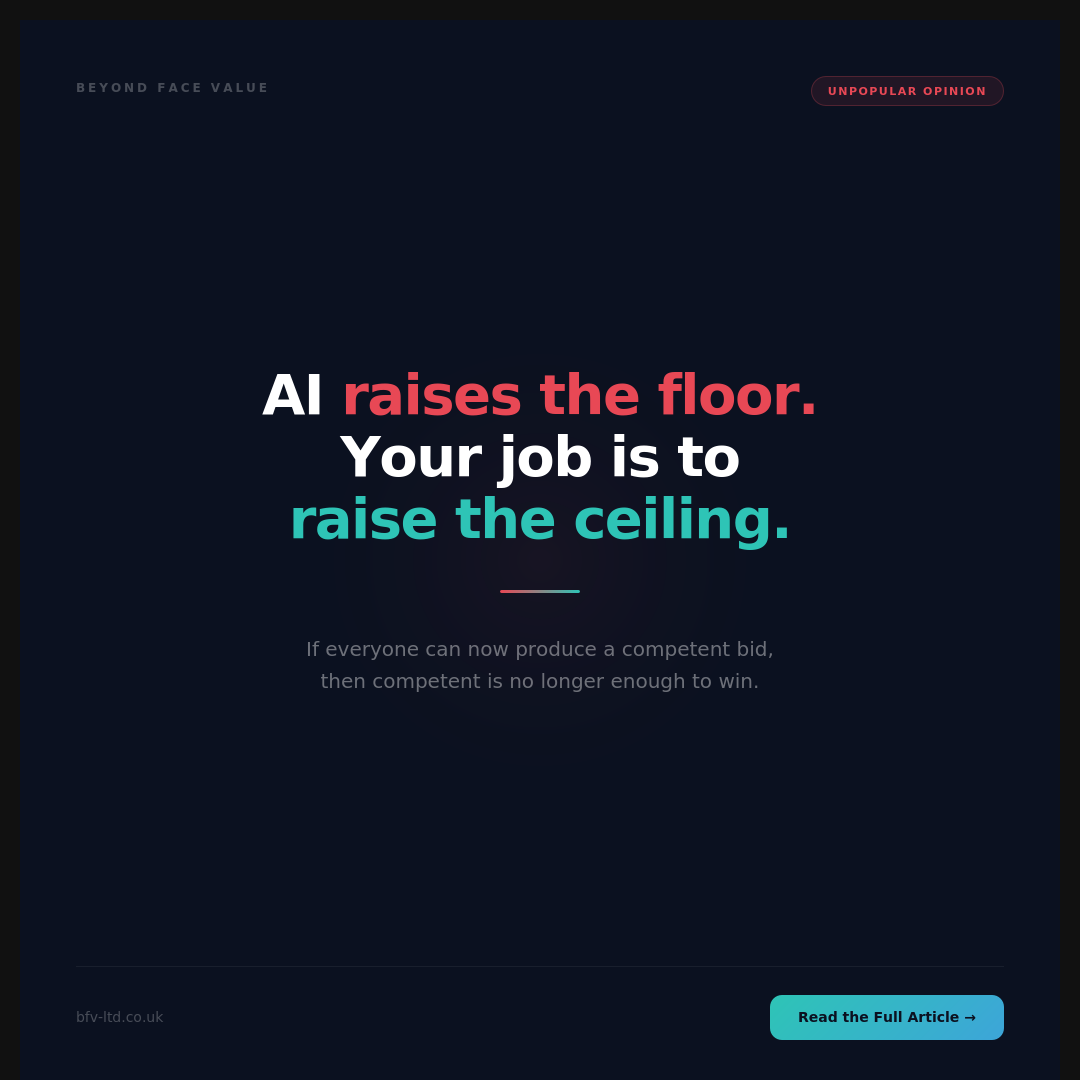
4. AI Is Raising the Floor, Which Means You Need to Raise the Ceiling
Let’s talk about the elephant in the room. AI is transforming bid writing, and pretending otherwise is a losing strategy.
AI tools can now draft first versions of standard tender sections, analyse requirements documents in minutes, check compliance, suggest evaluation-aligned language, and even automate bid/no-bid decisions. For SMEs with small teams and tight deadlines, this is genuinely useful.
But here’s the catch: if AI makes it easier for everyone to produce a competent response, then competent is no longer enough to win.
Bidders who previously submitted weak, non-compliant responses can now use AI to reach an acceptable standard. That means the middle of the pack is getting more crowded. The businesses that were already producing “good enough” submissions now need to produce something genuinely distinctive to stand out.
Where AI helps:
- Analysing tender documents and extracting key requirements
- Drafting first versions of standard sections (company profile, methodology outlines)
- Compliance checking before submission
- Repurposing strong content from previous winning bids
Where AI falls short:
- Understanding the client’s real priorities and hidden hot buttons
- Developing a genuinely differentiated win strategy
- Writing with the specificity that evaluators reward (“we will do X for you” not “we can do X”)
- Bringing real-world delivery insight that no language model can fabricate
What this means for your business: Use AI as a tool, not a crutch. Let it handle the grunt work so your team can focus on what actually wins bids: strategy, client insight, and specificity. The evaluator doesn’t care how you wrote the response. They care whether it answers their question, addresses their priorities, and gives them confidence that you’ll deliver. AI can help you get there faster. It can’t replace the thinking that gets you there at all.
5. The Government Commercial Agency Launches in April
The Cabinet Office has announced the creation of a new Government Commercial Agency (GCA), launching in April 2026. While details are still emerging, the stated objectives include simplifying access to specialist procurement support, providing expert advice for complex procurements, and supporting organisations from planning through to delivery.
Alongside this, the results of the public procurement consultation (which closed in September 2025) are expected imminently — likely bringing further changes aimed at supporting small businesses, creating local jobs, and strengthening economic resilience.
What this means for your business: The direction of travel is clear. Government wants more SMEs winning public contracts. The machinery is being built to support that. But machinery doesn’t write your bids for you. The SMEs that benefit will be the ones that are already doing the basics well: qualifying opportunities properly, writing for the evaluator, pricing strategically, and learning from every outcome
So What Should You Do Now?
If you’re an SME in professional services, here are five actions you can take this month:
- Register on the Central Digital Platform if you haven’t already. This is where all public sector opportunities are heading.
- Build a bid/no-bid process. Stop bidding for everything and start choosing the right fights. Even a simple scorecard will transform your win rate. (We offer a free Bid/No-Bid Decision Template on our website.)
- Develop your social value proposition. Write down what your business genuinely contributes beyond the contract. Quantify it. Make it specific to the communities you operate in.
- Audit your recent bid responses. Read them as an evaluator would. Do they answer the question asked? Do they lead with client outcomes or company credentials? Are they specific or generic?
- Take the BFV Bid Health Check. It’s free, takes 5 minutes, and will show you exactly where your tendering process is falling short across 5 critical areas. You’ll get a personalised score, a maturity band, and specific actions. No sales pitch. Just clarity.
The procurement landscape in 2026 is more open to SMEs than it’s ever been. But “open” doesn’t mean “easy.” The businesses that win will be the ones that treat bidding as a discipline, not a reaction.
That’s what Beyond Face Value is here to help with.
Take the free Bid Health Check at bfv-ltd.co.uk and find out where you stand.
About Beyond Face Value
Beyond Face Value helps SMEs bid smarter, not harder. We provide bid strategy, capture planning, response review, and training for professional services firms that want to win more work and waste less effort.
www.bfv-ltd.co.uk