
THE HIDDEN COST OF LOSING
Most organisations underestimate what unsuccessful tendering actually costs.
A lost bid is not just a missed contract.
It is:
- Senior leadership time
- Technical SME inputs
- Commercial reviews / assessments
- Supply chain engagements / alignment
- Finance + Risk modelling
- Schedule development
- Disrupted operational focus
- Forecast volatility
And often, repeat effort.
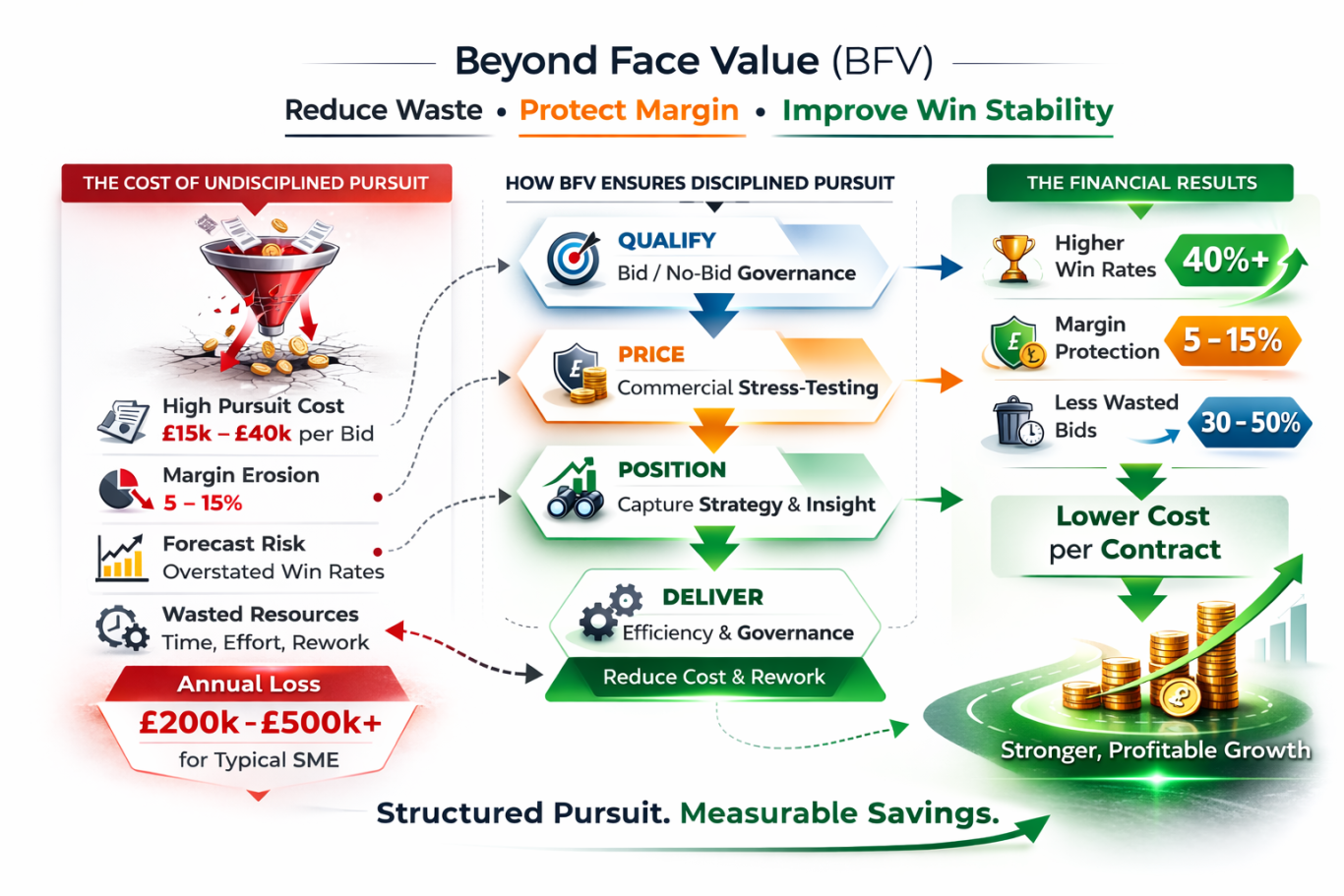
For many SMEs, a single major tender can consume £15,000–£40,000 of internal cost before submission.
If qualification discipline is weak, that investment was structurally exposed from the start.
The More Expensive Risk: Winning Poorly
Winning at the wrong margin is worse than losing.
Common financial leakage occurs when:
- Pricing risk is underestimated
- Mobilisation costs are compressed
- Contract exposure is not stress-tested
- Delivery capability is overstretched
The result:
- Margin erosion of 5–15% during delivery.
That is not growth. It is delayed loss.
Where Money Is Quietly Lost
Without structured pursuit architecture, organisations typically lose money in four areas:
- Pursuit Waste
Submitting bids with low structural probability. - Margin Exposure
Winning work without fully modelling commercial risk. - Forecast Volatility
Overestimating pipeline conversion and hiring prematurely. - Internal Inefficiency
Rework, late-stage chaos, duplicated effort.
These costs rarely appear on a P&L line labelled “bid inefficiency.” But they compound over time.
How BFV Protects Commercial Value
Beyond Face Value strengthens the commercial discipline behind competitive tendering by focusing on:
- Bid / no-bid governance before resource is committed
- Early capture positioning and competitive realism
- Commercial stress-testing prior to submission
- Margin protection through structured modelling
- Probability-aligned pipeline forecasting
We do not increase bid volume.
We improve cost-per-win efficiency and reduce structural exposure.
What CFOs Should Be Asking
- Is our bid / no-bid model formally governed?
- Do we measure cost per successful contract?
- Are win rate assumptions grounded in structured evidence?
- Is pricing stress tested against delivery risk?
- Are we pursuing strategically aligned revenue or reacting to opportunity flow?
If these questions are difficult to answer with confidence, structural exposure likely exists.
A Commercial Illustration
If your organisation:
- Submits 10 bids per year
- At an internal cost of £20,000 each
- With a 20% win rate
You are investing £200,000 to secure two contracts.
Improving qualification discipline and win stability materially reduces cost per successful contract and prevents avoidable pursuit spend.
The most expensive bid is not the one you lose.
It is the one you should never have pursued.
Why This Matters to Leadership Teams
Inconsistent win rates create:
- Revenue instability
- Resource misalignment
- Reactive decision-making
- Margin compression
Structured governance reduces financial exposure before submission risk is taken.
Our Position
Beyond Face Value exists to reduce:
- Waste
- Margin leakage
- Forecast distortion
- Reactive pursuit behaviour
We bring commercial discipline to competitive growth.
Finally...
If tendered revenue drives your growth,
structural inefficiency is more expensive than intervention.
Book a structured discussion to identify where financial exposure exists within your current pursuit model.